What is a spread formation in flag football and why does it work?
Spread is an alignment that uses the full width of the field, splitting receivers far enough apart that no defender can cover two of them and no two defenders can help each other. It works because space is the one thing a defense cannot add to. Every yard between two of your receivers is a yard a defender has to cover on foot, and against a defense that is already short of bodies, that arithmetic decides the play before anybody runs a route.
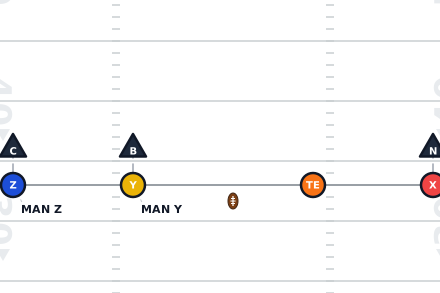
Spread, against man. Four isolated matchups and nobody close enough to help anybody. Spread does not beat man coverage; it makes man coverage answer the same question four times.
Why it works
Space is the one thing a defense cannot add
You can coach effort, technique and communication. You cannot coach a defender into being in two places, and spread's only argument is that he has to be.
It removes help before the snap
Two defenders standing thirty yards apart cannot bracket anybody, cannot pass anybody off and cannot cover for each other's mistakes. The alignment has taken all of that away for free.
It makes every other formation mean something
Bunch, stack and compressed are all departures from spread, and a defense only has to adjust to them if it has seen you use the width first. Spread is the baseline the rest of your formations are measured against.
What to run from it
- Four VerticalsThe widest possible starting points make a three-deep zone cover more grass than it can, and the seams open.
- All HitchesIf they play off to handle the width, every receiver has a five-yard throw in front of him.
- Slant-FlatWidth forces defenders to widen, and a slant attacks the exact space they widened out of.
- BubbleThe punishment for a defense that refuses to cover the width: throw it out there and let the receiver run.
How to line up in spread
- 1
Put your outside receivers near the sideline
As wide as the rules and the field allow. Their job is to take a defender out of the middle whether they get the ball or not.
- 2
Space the inside receivers evenly
Halfway between the outside man and the ball is a good default. Uneven splits create a natural overload, which is useful when you mean it and a mess when you do not.
- 3
Keep the quarterback's launch point clean
Width only helps if the ball can get there. Nobody should be aligned where they will be standing in the throwing lane at the moment of the decision.
- 4
Decide what the width is for
Spread either creates a one-on-one you want or empties the middle for somebody else. If it is doing neither, it is just a wide formation.
What it gives you, format by format
5v5
The default for a reason: five defenders cannot cover a full width field and still help each other. Spread is how a 5v5 offense turns the sideline into an extra blocker, and it is usually the first formation a new coach should learn.
NFL Flag
An eligible centre means you can spread four and still snap it. The width forces the defense to choose between covering the field and covering the middle, and the centre releasing into the middle is the punishment for choosing width.
7v7
Enough receivers to spread and still have somebody inside. This is where spread stops being a way to survive and becomes a way to pick a matchup.
11v11
The base of most modern offenses, and its real job is arithmetic in the box. Every receiver you split out is a defender who has to leave the middle, which is why spread formations and the run game are allies rather than opposites.
How the defense answers it
Play zone and make them earn every yard
Width hurts man coverage most, because man has to travel. Zone defenders cover grass, and grass does not get tired.
Squeeze the splits with alignment
Line up inside the receivers and force them to work back toward the middle where your help is. You are conceding the sideline to protect everything else.
Rush, because spread cannot help anybody
Receivers split wide are receivers not available to help with anything. Spread is the formation most exposed to a rush that arrives on time.
Take the inside receiver away first
The widest receiver is the least dangerous, because the throw is longest and the sideline is helping you. Cover from the inside out and let the sideline do the work.
When not to call it
In a strong wind or on a narrow field
The formation is a bet on the ball travelling sideways efficiently. Both of those make the bet worse, and neither is your receivers' fault.
Near the goal line
There is no width to trade on inside the ten, and the deep space spread creates does not exist. Compressed and bunch are the answers there.
When the rush arrives before the receivers do
Wide receivers are far away, and far away takes time. If the ball has to be out in two seconds, the width is a liability rather than an asset.
Take it to your team
Draw your plays in the flag football play creator, collect them in the flag football playbook builder, and print printable play cards so every player knows them come Saturday.
Build a spread formation
Set the splits where you want them, draw the releases, and save it as a formation you can reuse.
Open the designerRelated questions
What is a spread offense in flag football?
Is spread the best formation for 5v5?
What is the difference between spread and empty?
How do you defend a spread formation?
Related guides
Coach Ray Carroll
Coaches 5v5 flag football from kindergarten through 7th grade in San Mateo and San Carlos, California, and built RC Football to design, teach and print the plays his own teams run.