Flag and tackle football drills, sorted by age and skill.
You do not arrive at practice wanting "a drill". You arrive with nine kids, forty minutes and a team that cannot pull a flag. The RC Football drill library lets you subtract down to the drills that fit: tick the skill, the age and what went wrong on Saturday, and read the rows that are left. 51 drills, each drawn as a diagram, each ready to drop into a practice plan.
Four Drills, Straight From the Library
4 drills · 4 written
Sort · shortest first
6 minages 5+2 playersA corner of the field
SetupPairs five yards apart, one ball carrier, one defender, cones for a lane.
Coaching pointEyes on the hips. The ball lies, the belt does not.
6 minages 6+2 playersA corner of the field
SetupPairs five yards apart, one tennis ball. Twenty catches each, fingertips only.
Coaching pointA tennis ball cannot be caught with your chest. That is the whole point.
6 minages 5+2 playersA corner of the field
SetupCenter and quarterback only. Twenty snaps, no rush, count the clean ones.
Coaching pointThe snap is a handoff you throw. Same hands every time.
10 minages 10+3 playersHalf a field
SetupCone at ten yards. Receiver stems outside, breaks in.
Coaching pointSell the stem with your eyes before your feet.
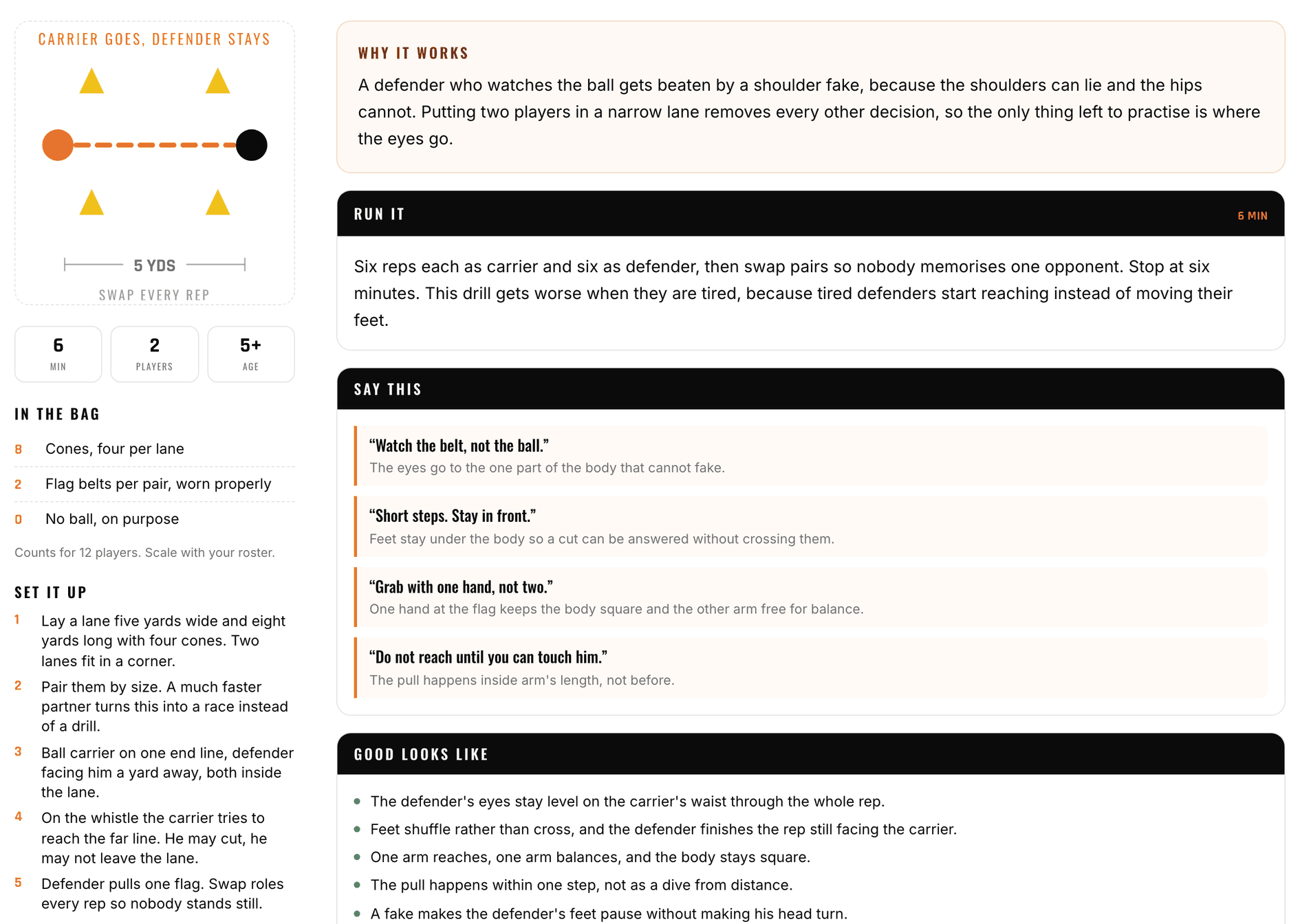
Every drill teaches you how to coach it
Tap any drill and it opens into a full coaching page. We tell you what to coach and what to look for during practice: the exact words to say, what good looks like, and the mistakes to catch before they become habits, so your team is sharp in the game. See this drill in full.
Skills in the library today
- Catching
- Open field running & jukes
- Route running
- Getting open
- Handoffs
- Throwing
- Snapping & center exchange
- Flag pulling
- Playing the ball
- Zone defense
- Man defense
- Pursuit angles
- Backpedal & hip turn
- Reading keys & fakes
- Rushing the passer
- Contain & setting the edge
- Communication & alignment
- Acceleration
- Conditioning
- Reaction & first step
- Agility & change of direction
- Warm-up & activation
- Lateral movement
- Footwork
- Sharks & minnows
- Ultimate football
- Flag tag
- Accuracy knockout
- Relay races
- Gauntlet
A Finder, Not a List
Most drill collections are a long page you scroll until something looks close enough. The drill library is built the other way round: every box you tick takes drills away until what is left fits the practice you are actually running. Filter by skill, by the age you coach, or by what went wrong on Saturday (“we miss flags”, “they burn us outside”, “our QB has no time”), and flip the lens between flag and tackle. Each drill is drawn as a drill box, so you can see the setup before you read it, and every drill has its own page with the setup step by step, the cues to say and the reps. When it is the one, add it to a practice plan without leaving the row.
What is in the library
- 51 drills each with a diagram, a setup, a coaching point and its own page.
- Filter by skill and the rows narrow to drills that train it.
- Filter by what went wrong on Saturday, in plain coach language.
- Filter by age, 5 to 6 to 11 and up so a drill never lands on kids it was not written for.
- Minutes, players and space on every row: a corner of the field, half a field, full field.
- Add to practice plan from any row, then build the rest of the session around it.
How the Drill Library Works
- 1
Pick flag or tackle
The lens at the top of the rail. Flag is the default. Switch to tackle and the drills that belong to the tackle game come with you.
- 2
Tick what you need
Skill, age, or what went wrong. Two boxes in one group widen the list, a box in another group narrows it, which is how every good filter works.
- 3
Read the rows
Each row leads with minutes, ages, players and field space, then the setup and the coaching point. The drill box shows the setup at a glance.
- 4
Open the drill
Tap a name for the full page: setup step by step, the equipment list, cues to say, what good looks like, reps, and an easier and a harder version.
- 5
Add it to a practice plan
Press Add to practice plan on the row and choose where it goes. The drill lands in the practice planner with its minutes, ready to print or run from your phone.
What Every Drill Carries
A drill box, not a play diagram
Cones, bodies, paths
A play diagram is a wide field with yard lines. A drill box is a small bounded coaching area with cones in it, drawn to the drill's real setup, so you can tell at a glance which kind of thing you are looking at and how to lay it out.
Setup and coaching point
On the row, before you click
One line on how to set it up and one on what to coach. The finder shows the real content, not a teaser, so a coach scanning between drills on the sideline gets something he can use without opening anything.
The full drill page
Cues, equipment, reps, progressions
Setup in order, the equipment for a real roster, what to say and why, the mistake each cue corrects, what good looks like so a parent helper could score it, when to stop, and how to make it easier or harder for the age in front of you.
A bridge into your practice
Add to practice plan
The library and the planner are one flow. Pick a drill here, choose the period it belongs in, and it lands on the practice sheet with its minutes. Print the plan with every drill's directions attached, or run it from your pocket.
Building the whole session? The practice planner is built from this library, so every drill here is a block you can drop into a plan.
Who Uses the Drill Library
- Volunteer flag coaches planning tonight's practice with a roster of eight and half a field
- Coaches who watched something go wrong on Saturday and want the drill that fixes it
- Youth coaches who need drills that suit five and six year olds, not a high school list
- Assistant coaches running a station who need the setup and the cue in one place
- League directors handing new coaches a place to start that is not a search engine
Drill Library FAQ
Is the drill library free?
How many drills are in it?
Where do I find football drills for 6, 8, 10 or 12 year olds?
Can I filter by how long a drill takes or how much space it needs?
Are there tackle football drills?
Can I print a drill?
Keep exploring
Find the drill that fixes Saturday.
Tick the skill, the age and the problem. Read what is left.
Browse the Drill Library