NFL Flag Offense
The best plays in NFL Flag are the fast ones, starting with Mesh, where the center is one of the two crossers. The quarterback may not run across the line and the clock gives him seven seconds, so every NFL Flag play is a quick throw or a handoff, and a handoff costs you something no other format charges.
Pick your format
Everything below is written for this format. Press the pill again for all of them.
What changes at NFL Flag
The center is a receiver
He snaps and releases on every down, and on Mesh he is one of the crossers. Plain 5v5 puts a running back in that spot and cannot draw the same play, which is why these diagrams are drawn for NFL Flag and not borrowed.
A handoff frees the whole defense to rush
The moment the ball changes hands, the pass clock is gone and every defender may rush instead of the usual limit. A back who is not through the line immediately is running into the entire defense.
Whoever takes the snap is the quarterback
The rulebook defines him by the snap, so a direct snap to a back does not create a runner: that is why the wildcat is illegal here and every run on this hub starts with a handoff.
Start here
- 1Mesh in NFL FlagThe fastest concept in the book, with the center as a crosser, which only this format can draw.
- 2The NFL Flag diveWhat a handoff really costs here, and how to make the back beat the rush that follows it.
- 3Flood in NFL FlagThe zone answer, run with the center as one of the three levels.
Concepts
Four passing concepts are written for NFL Flag's own rules, the four the rulebook genuinely changes. Four Verticals is the same play as in plain 5v5, so its card opens the five-a-side page. The first two simulate for everyone; the rest need a Coach account.
 Mesh
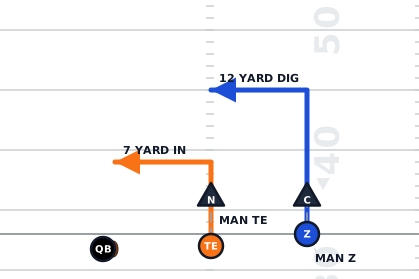
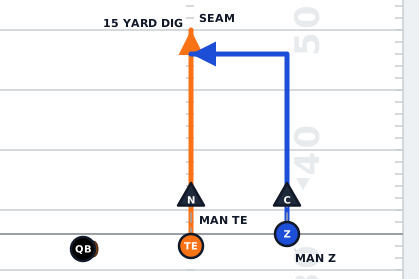
MeshTwo crossers run opposite ways two yards apart, so any defender chasing one has to get through the other.
QB reads
Which crosser comes out of the traffic clean. It is a look, not a progression.vs Man
Both defenders arrive on the same grass at the same moment. One goes over, one goes under, and whoever goes under is late. Flood
FloodThree routes to one side at three depths, flat then out then sail, stacked in a single vertical slice of field.
QB reads
High to low. Look at the sail first; the moment a defender commits, the level above or below him is open.vs Man
Three routes, three defenders, nobody wrong. Against man a flood is three separate races down one sideline. Four Verticals
Four receivers running straight, spaced so no deep defender can cover two of them.
QB reads
Count the deep defenders before the snap. Three deep means the seams win; two deep means the middle does.vs Man
Four one-on-one races with no help. The concept is doing nothing. Whoever is losing his matchup is the throw. Spot
SpotA corner over the top, a hitch sitting underneath and a flat running away from both, a triangle out of one bunch.
QB reads
The flat defender. If he runs with the flat, the hitch is open behind him; if he sits, throw the flat.vs Man
Traffic. Three receivers off one spot means three defenders trying to follow through the same two yards of grass. Smash
SmashA hitch at five yards under a corner route at twelve, both to the same side and in the same throwing window.
QB reads
The deepest of the two defenders. If he stays, take the hitch; if he leaves, the corner is behind him.vs Man
No conflict at all. The corner sits on the hitch, the safety runs the corner route, and smash becomes two separate one-on-ones. Slant-FlatSoon
One receiver breaking inside, a back running outside underneath him. Two routes, opposite directions, one defender between them.
QB reads
The flat defender, and nobody else. He picks one and you throw the other. One read, one beat.vs Man
Both are covered by whoever is on them. The flat is a hard cover from inside leverage, the slant a hard cover from outside. StickSoon
An inside receiver to five yards who sits down against zone and keeps running against man, with a flat route under him.
QB reads
Read the coverage off the stick route itself: if he sat, it is zone and he is open; if he ran, it is man and you have the flat.vs Man
The stick never stops, so the defender never gets to pass him off. It is a chase, and the flat underneath is a second problem. Double SlantsSoon
Two receivers on the same side both breaking inside, stacked so one defender is between them.
QB reads
Whichever slant the inside defender does not take. Fast, flat and off the back foot.vs Man
Two inside breaks from outside leverage. Both defenders are running across the field with no help inside them.
Formations
Where everyone lines up before the ball moves. Every formation page covers each team size in its own section, so these are the same twelve wherever you coach.
 Bunch
BunchThree receivers clustered inside about six yards, usually to one side, with nothing outside them.
What it creates
Traffic before the snap. Three defenders have to stand in one small square of grass, then the receivers leave it in three directions.vs Man
Three defenders in a space the size of a car, each obliged to follow somebody out of it. Whoever guesses wrong is beaten at the snap, and nobody has run a route yet. Trips
TripsThree receivers to one side, spread across the field rather than clustered, and one or none to the other.
What it creates
An arithmetic problem. Three receivers running into two defenders' areas leaves somebody uncovered before anyone has run a good route.vs Man
Man travels with the receiver rather than the space, so spreading out costs the defense nothing. Three defenders follow three receivers and trips has bought you very little. Stack
StackTwo receivers on one track, one directly behind the other, rather than side by side.
What it creates
A free release for the back man. Nobody can get hands on him without going through the receiver in front, so he leaves the line clean every time.vs Man
Two defenders standing in each other's way, having to agree before the snap on who takes the front man and who takes the back one. Whichever they pick, one of them starts late. Empty
EmptyNobody in the backfield. Every eligible player is split out, and the quarterback stands alone.
What it creates
Maximum receivers and a defense with nothing left to guess about. Every player who could catch it is already where he is going to start from.vs Man
Everybody is covered and nobody is spare, because the offense has put every eligible on the field and the defense has had to answer each one.
NFL Flag play collection
From the premium collection: diagrams without the written breakdowns the concepts above have.
Double Slants
Quick GameBoth outside receivers slant inside off a three-step stem while the centre runs the corner behind them and the back swings to the left flat. The two slants and the corner attack the same side of the field at three different depths, so a defender who jumps the slant is the one who just vacated the corner. The fastest ball in the install. If the rush is honest, this is out of the quarterback's hand before it arrives. Source: NFL FLAG 2024 Playbook, Single Back Play 1 (p7).
Scissors
CrossingX posts from the left and the centre runs a corner to the same side, so the two deep routes cross and swap the defenders covering them. Against man that collision is the play; against zone the corner sits down outside the safety. The back's flat route to the right and Z's straight go are the outlet and the clear-out. Nobody on that side is meant to catch it unless the defense overplays the crossing pair. Source: NFL FLAG 2024 Playbook, Single Back Play 2 (p8).
Y Option
OptionThe slot stems to six and breaks whichever way the defender does not, and that read IS the play, and the quarterback makes it with him. The centre drags underneath to hold the short defender and both outside receivers run vertical to clear the room the option needs. Teach the receiver and the quarterback to read the same shoulder and this is the highest-percentage throw on the sheet. Source: NFL FLAG 2024 Playbook, Spread Play 1 (p11).
Post Dig
High-LowZ posts over the top and the slot digs in underneath him at eight, which puts two in-breaking routes on the same defender at two depths. He can carry one of them. The centre drags away to the right to widen the short zone and X runs an option on the backside for the ball the coverage gives back. Best against a single deep defender. Source: NFL FLAG 2024 Playbook, Spread Play 2 (p12).
Curl Out
High-LowZ curls back at eleven and the slot breaks out at six underneath him. The outside defender has to choose, and whichever he takes the other is open behind or in front of him. X runs the deep post to carry the help away and the centre crosses to the left to keep the middle occupied. This is the answer when the defense sits in a soft shell and dares you to throw short. Source: NFL FLAG 2024 Playbook, Spread Play 3 (p13).
Bunch Mesh
CrossingOut of the tight bunch, X and Z cross underneath in opposite directions while Y posts and the centre runs the corner. Four men leaving one cluster in four directions is very hard to play man against. Defenders run into each other before the routes even develop. Tell the crossers to stay flat and take the width; the depth belongs to the post and the corner. Source: NFL FLAG 2024 Playbook, Bunch Play 1 (p15).
Double Corner
VerticalBoth outside men of the bunch break to the corners at eight, splitting the deep coverage two ways at once, and Y drags to the left underneath with the centre crossing right behind him. Two corners from one bunch means the deep defenders cannot pass either one off. They have to run with them from a standing start. Use it after the crossing plays have made them squeeze. Source: NFL FLAG 2024 Playbook, Bunch Play 2 (p16).
Spacing
SpacingFour routes at fixed depths and fixed widths: corners from X and Y over the top, the centre digging left at six and Z breaking out at six. Nobody is trying to beat anybody. The routes simply occupy every window at once and the quarterback throws to whichever one the defense left empty. The call for a young team that needs a completion rather than a matchup. Source: NFL FLAG 2024 Playbook, Bunch Play 3 (p17).
Stick
OptionThe inside man of the trips options at six, the middle man breaks out at five underneath him and Z runs off the top. It is the classic stick triangle: the flat defender cannot cover the out and the option at the same time, and the option man reads him and sits in whatever he vacates. The centre's corner route on the backside is the shot if they roll everything to the trips. Source: NFL FLAG 2024 Playbook, Trips Play 1 (p19).
Drag Corner
CrossingX drags all the way back across to the weak side while Y breaks to the corner and Z clears deep. The drag pulls the underneath coverage one way and the corner attacks the space it leaves. The centre digs to the trips side at six as the middle read. Against man the drag is running away from everybody; against zone take the dig. Source: NFL FLAG 2024 Playbook, Trips Play 2 (p20).
Corner Curl
High-LowZ drives to ten and hooks back INSIDE while Y breaks to the corner over the top of him. The deep defender cannot sit on the curl and carry the corner, and the two routes break in opposite directions off the same stem. X options underneath and the centre digs away to the left. Throw the curl on time: it is only open for the step the defender spends turning around. Source: NFL FLAG 2024 Playbook, Trips Play 3 (p21).
Divide
VerticalFrom the stack, X releases to the corner and Y to the post: one deep defender, two routes going opposite ways around him. Z runs the seam between them to keep him honest in the middle and the centre digs left underneath everything. The stack is what makes it work: the defenders cannot line up on anybody, so they find out which route they have after it has already started. Source: NFL FLAG 2024 Playbook, Trips Stack Play 1 (p23).
Showing 12 of 40. See the whole NFL Flag collection.
Run game
Seven runs written for NFL Flag, every one a handoff, because a quarterback who receives the snap may not run and a direct snap does not get around it.
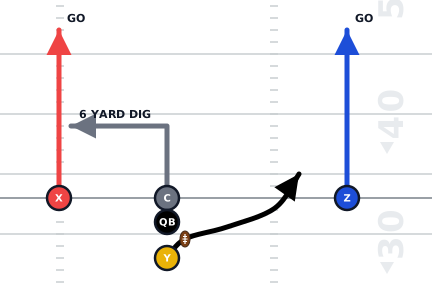 Sweep
SweepThe ball carried wide and turned upfield outside everybody, before the defense can get there to meet it.
The read
The last defender with outside leverage. If he stays home you cut up inside him; if he chases inside you keep going and beat him to the corner.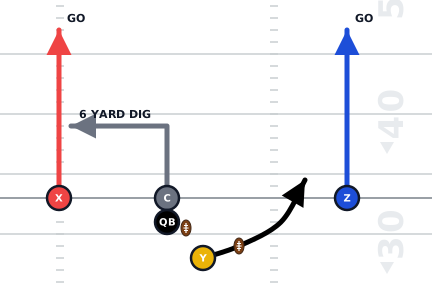 Toss
TossA sweep with a faster delivery: the ball pitched to a back who is already running wide, so it reaches the edge half a second sooner than a handoff could.
The read
The same key as the sweep: the last defender with outside leverage. The toss buys the runner an extra look at him before he has to decide.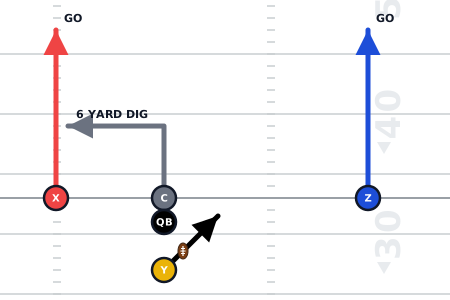 Dive
DiveThe ball handed straight ahead through the middle, as fast as the exchange allows. No angle and no race, just the shortest distance to the yards you need.
The read
The middle defender. If he sits in the hole, the back takes what the collision gives; if he drops into coverage, the hole was his and he has left it.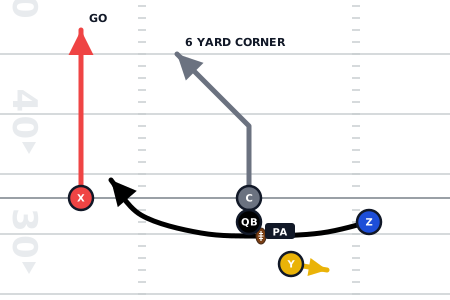 Jet Sweep
A receiver in full-speed motion takes the handoff as he passes the quarterback and keeps going. He reaches the edge already at top speed, and nobody standing still can match that.
The read
Whether anybody ran with the motion. If nobody did, you have one more player to that side than they do; if somebody did, the side he left is a man short.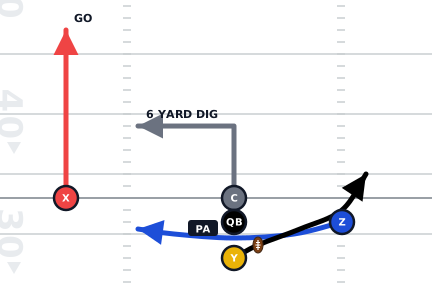 Counter
The back takes one step one way to pull the defense with him, then takes the ball back the other way into the space they just left.
The read
The defender on the side the play finishes. If he chased the first step, the counter is open; if he stayed home, the fake bought nothing.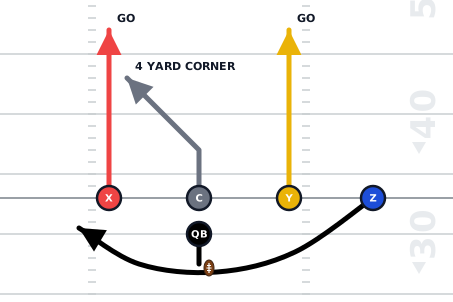 Reverse
The ball starts wide one way, then a receiver coming back the other way takes it from the runner. The ball changes direction, and so, a second too late, does the defense.
The read
The defender on the far side. If he chased the sweep, the reverse has that whole side to itself; if he stayed home, it is a slow play into a man who was waiting for it.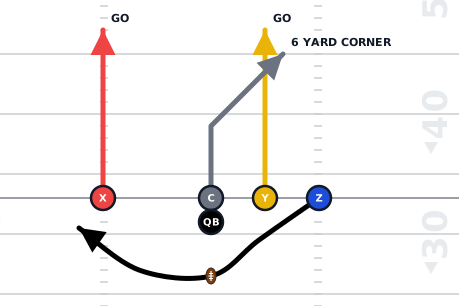 End Around
A receiver comes around behind the quarterback and takes the ball going the other way. One handoff, not two: a reverse without the part that gets fumbled.
The read
The defender on the far side, the same as the reverse. Whoever is on the side the receiver finishes has to decide whether the fake inside is real.
By situation
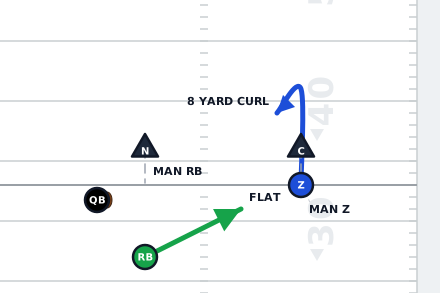
NFL Flag shares its situational answers with plain 5v5, the same five-player arithmetic. What to carry over is that your quarterback cannot scramble his way out of pressure.
By age and level
The same game, scaled to what the players can actually execute.
- 5 to 6 year oldsThe first catch
Everybody stops, turns around, and the ball is already there.
6 playsOpen - 7 to 8 year oldsThe second read
The quarterback can look at one receiver, decide, and come off him.
6 playsOpen - 9 to 10 year oldsThe first concept
Two receivers working together on purpose instead of two receivers running.
6 playsOpen - 11 to 12 year oldsThe full progression
One, two, three and the checkdown, in rhythm and without being told.
6 playsOpen - High schoolTighter windows
Defenders who close. The ball has to be out before the receiver breaks.
5 playsOpen - Adult recNo install time
Everything has to work the first time you call it, explained in the huddle.
5 playsOpen
Change any of these for your NFL Flag team
Open the play, move the routes, save it to your playbook.
Open the designer